Blog Archive

Αλέξανδρος Γ. Σφακιανάκης

Thursday, May 26, 2022

Concomitant and Exceedingly Rare Causes of Oropharyngeal Dysphagia

alexandrossfakianakis shared this article with you from Inoreader

olo220006f1_1653404741.38932.png?Expires

This case report describes a man in his 40s who presented with a 5-month history of worsening dysphonia and dysphagia and was subsequently diagnosed with extranodal natural killer/T-cell lymphoma.
View on Web

Airway Complications Resulting From Pediatric Esophageal Button Battery Impaction

alexandrossfakianakis shared this article with you from Inoreader

orv220002f1_1653404718.87583.png?Expires

This systematic review investigates pediatric airway injuries and their long-term sequalae after button battery ingestion.
View on Web

Magnetic resonance guided adaptive stereotactic body radiotherapy for lung tumors in ultracentral location: the MAGELLAN trial (ARO 2021-3)

alexandrossfakianakis shared this article with you from Inoreader

13014.jpg

Stereotactic Body Radiotherapy (SBRT) is a standard treatment for inoperable primary and secondary lung tumors. In case of ultracentral tumor location, defined as tumor contact with vulnerable mediastinal stru...
View on Web

Comparative single-cell RNA-sequencing profiling of BMP4-treated primary glioma cultures reveals therapeutic markers

alexandrossfakianakis shared this article with you from Inoreader
Abstract
Background
Glioblastoma (GBM) is the most aggressive primary brain tumor. Its cellular composition is very heterogeneous, with cells exhibiting stem-cell characteristics (GSCs) that co-determine therapy resistance and tumor recurrence. Bone Morphogenetic Protein (BMP)-4 promotes astroglial and suppresses oligodendrocyte differentiation in GSCs, processes associated with superior patient prognosis. We characterized variability in cell viability of patient-derived GBM cultures in response to BMP4 and, based on single-cell transcriptome profiling, propose predictive positive and early-response markers for sensitivity to BMP4.
Methods
Cell viability was assessed in 17 BMP4-treated patient-derived GBM cultures. In two cultures, one highly sensitive to BMP4 (high therapeutic efficacy) and one with low sensitivity, response to treatment with BMP4 was characterized. We applied single-cell RNA-sequencing, analyzed the relative abundance of cell clusters, searched for and identified the aforementioned two marker types, and validated these results in all 17 cultures.
Results
High variation in cell viability was observed after treatment with BMP4. In three cultures with highest sensitivity for BMP4, a substantial new cell subpopulation formed. These cells displayed decreased cell proliferation and increased apoptosis. Neuronal differentiation was reduced most in cultures with little sensitivity for BMP4. OLIG1/2 levels were found predictive for high sensitivity to BMP4. Activation of ribosomal translation (RPL27A, RPS27) was upregulated within one day in cultures that were very sensitive to BMP4.
Conclusion
The changes in composition of patient-derived GBM cultures obtained after treatment with BMP4 correlate with treatment efficacy. OLIG1/2 expression can predict this efficacy, and upregulation of RPL27A and RPS27 are useful early-response markers.
View on Web

Wednesday, May 25, 2022

Clinical outcomes and cost-effectiveness of superficial parotidectomy versus extracapsular dissection of the parotid gland: a single-centre retrospective study of 161 patients

alexandrossfakianakis shared this article with you from Inoreader
Improvements in preoperative diagnostics and intraoperative techniques have made the surgical excision of benign parotid gland tumours less invasive. Extracapsular dissection (ECD) has become more popular in comparison to superficial parotidectomy (SP), the gold standard. Although clinical outcomes have been reported, reports on cost-effectiveness are limited. The aim of this retrospective study was to analyse the surgical outcomes and cost-effectiveness of ECD versus SP in benign parotid tumour surgery. (Source: International Journal of Oral and Maxillofacial Surgery)
View on Web

The use of self‐report questionnaires in an analysis of the multidimensional aspects of pain and a correlation with the psychological profile and quality of life in patients with Burning Mouth Syndrome: a case control study

alexandrossfakianakis shared this article with you from Inoreader

Abstract

Background

The symptomatology in Burning Mouth Syndrome (BMS) is complex and it should be considered in accordance with a biopsychosocial model.

Objectives

To evaluate the multidimensional aspects of pain with a complete battery of tests and to analyse its relationship with potential predictors such as mood disorders, sleep and quality of life.

Methods

40 patients with BMS vs an equal number of age and sex-matched healthy controls were enrolled. The VAS, SF-MPQ, BPI, PD-Q, BDI-II, STAI, PSQI, ESS, SF-36 and OHIP-14 were administered.

Results

The scores of the VAS, SF-MPQ, BPI, PD-Q, BDI-II, STAI, PSQI, SF-36 and OHIP-14 were statistically significantly higher in the BMS patients than the controls (p < 0.001**). A strongly linear correlation between pain (VAS, SF-MPQ, BPI and PD-Q) and disease onset (STAI, BDI-II, PSQI and sub-items of SF-36 and OHIP-14) was found. In the multiple regression analysis, the contributions of the BDI-II and OHIP-14 were found to be statistically significant with the SF-MPQ, PD-Q and BPI in terms of severity and interference, while the contributions of the STAI and sleep were found to be statistically significant with the SF-MPQ and BPI in terms of severity and interference, respectively.

Conclusions

Pain tests are differently correlated with mood and quality of life. Therefore, a complete analysis of the patient requires several tools to better understand the multidimensional aspects of pain in BMS.

View on Web

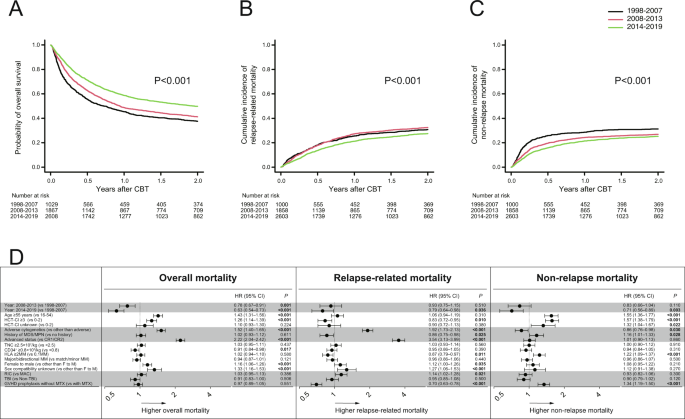
Improved trends in survival and engraftment after single cord blood transplantation for adult acute myeloid leukemia

alexandrossfakianakis shared this article with you from Inoreader

41408_2022_678_Fig1_HTML.png

Blood Cancer Journal, Published online: 25 May 2022; doi:10.1038/s41408-022-00678-6

Improved trends in survival and engraftment after single cord blood transplantation for adult acute myeloid leukemia
View on Web