Blog Archive

Αλέξανδρος Γ. Σφακιανάκης

Monday, June 10, 2019

Ethics

The Moral Complexity of Agriculture: A Challenge for Corporate Social Responsibility

Abstract

Over the past decades, the modernization of agriculture in the Western world has contributed not only to a rapid increase in food production but also to environmental and societal concerns over issues such as greenhouse gas emissions, soil quality and biodiversity loss. Many of these concerns, for example those related to animal welfare or labor conditions, are stuck in controversies and apparently deadlocked debates. As a result we observe a paradox in which a wide range of corporate social responsibility (CSR) initiatives, originally seeking to reconnect agriculture and society, frequently provoke debate, conflict, and protests. In order to make sense of this pattern, the present paper contends that Western agriculture is marked by moral complexity, i.e., the tendency of multiple legitimate moral standpoints to proliferate without the realistic prospect of a consensus. This contention is buttressed by a conceptual framework that draws inspiration the contemporary business ethics and systems-theoretic scholarship. From the systems-theoretic point of view, the evolution of moral complexity is traced back to the processes of agricultural modernization, specialization, and differentiation, each of which suppresses the responsiveness of the economic and legal institutions to the full range of societal and environmental concerns about agriculture. From the business ethics point of view, moral complexity is shown to prevent the transformation of the ethical responsibilities into the legal and economic responsibilities despite the ongoing institutionalization of CSR. Navigating moral complexity is shown to require moral judgments which are necessarily personal and contestable. These judgments are implicated in those CSR initiatives that require dealing with trade-offs among the different sustainability issues.


Pain in Pig Production: Text Mining Analysis of the Scientific Literature

Abstract

Public's concern about poor animal welfare provided by intensive farming systems has increased over the last decades. This study reviewed the interest of the scientific research on the pain issue in pig production to assess if the societal instances may be a driving force for the research activity. A literature search protocol was set up to identify the peer-reviewed papers published between 1970 and 2017 that covered the topic of 'pain in pigs' using Scopus®, database of Elsevier©. One hundred and thirty papers were selected and they were mainly focused on the practice of castration (64%) followed by tail docking (24%). The scientific community first focused on these painful practices as a way to improve production efficiency and quality issues while more recently, due to the increased pressure by the public opinion, turned its interest towards the search of alternative solutions. A text mining analysis on the abstract of the selected papers clearly indicated the effort of the research to explore solutions to alleviate pain. Evocative words of this target were the selected terms 'pharmacological analgesic' and 'anaesthetic treatments'. The text mining highlighted vocalizations as the main pain indicators in pigs as this term was frequently associated to 'acute stress'. Ethical issues were a minor research topic in the scientific literature on pig breeding but in the short run, they are supposed to become a major subject to justify the acceptance of the modern production systems at the eyes of the consumers.


How Farm Animal Welfare Issues are Framed in the Australian Media

Abstract

Topics related to ethical issues in agricultural production, particularly farm animal welfare, are increasingly featured in mainstream news media. Media representations of farm animal welfare issues are important because the media is a significant source of information, but also because the way that the issues are represented, or framed, defines these issues in particular ways, suggests causes or solutions, and provides moral evaluations. As such, analysis of media frames can reveal how issues are being made public and identify the cues that audiences are given to help them make sense of complex ethical issues. Previous research on media frames and animal welfare has tended to focus on single issues or events; however we sought to identify whether media frames extended across different farm animal welfare-related issues to investigate whether there is any commonality between issues. We analysed articles published in the mainstream press in Australia between 2014 and 2016 related to farm animal welfare, and identified two dominant frames: that governments and the farm animal production industries cannot be trusted to ensure good farm animal welfare; and that consumers can act to improve animal welfare through ethical consumption. These frames have implications for how the Australian public interpret and understand the roles and responsibilities of different actors in the food production system. This research also contributes to discussion about the role of the media in shaping public opinion about ethical issues in agriculture and how, in turn, the media landscape itself is being shaped by consumer attitudes.


Progress and Absurdity in Animal Ethics

Abstract

The development of animal ethics has been characterized by both progress and absurdity. More activity in animal welfare has occurred in the past 50 years than in the previous 500, with large numbers of legislative actions supplanting the lone anti-cruelty laws. Nonetheless, there remains a tendency to confuse animal ethics with human ethics. I found this to be the case when my colleagues and I were drafting federal law requiring control of pain in invasive research. The history of animal ethics vacillates between Descartes' denial of thought and feeling in animals and British empiricism, including the great skeptic David Hume, who affirmed in no uncertain terms the existence of animal mind. This approach was continued in British empiricism, culminating in the work of Charles Darwin. But despite Darwinian domination of biology and psychology, psychology was captured by denial of mind and consciousness by JB Watson, father of behaviorism. Denial of thought and feeling in animals continued in 20th century science and medicine while society in general became ever more firm in asserting their existence.


Varieties of the Cruelty-Based Objection to Factory Farming

Abstract

Timothy Hsiao defends industrial animal agriculture (hereafter, factory farming) from the "strongest version of the cruelty objection" (J Agric Environ Ethics 30(1):37–54, 2017). The cruelty objection, following Rachels (in: Sapontzis S (ed) Food for thought: the debate over eating meat, Prometheus, Amherst, 2004), is that, because it is wrong to cause pain without a morally good reason, and there is no morally good reason for the pain caused in factory farming (e.g., people do not need to eat meat in order to live healthy, flourishing lives), factory farming is morally indefensible.In this paper, I do not directly engage Hsiao's argument for the moral permissibility of factory farming, which has been done by others (Puryear et al. in J Agric Environ Ethics 30(2):311–323, 2017). Rather, my aim is to assess whether Hsiao's criticism of one version of the cruelty-based objection is a criticism of all versions of the cruelty-based objection, or objections to factory farming that appeal to the harm or suffering experienced by farm animals. I argue that there are, at least, four distinct kinds of cruelty-based objections to factory farming, distinguishable by their different moral principles or moral observations, and that Hsiao's criticism of one kind of cruelty-based objection does not generalize to the others.


The Ethics of Biosurveillance

Abstract

Governments must keep agricultural systems free of pests that threaten agricultural production and international trade. Biosecurity surveillance already makes use of a wide range of technologies, such as insect traps and lures, geographic information systems, and diagnostic biochemical tests. The rise of cheap and usable surveillance technologies such as remotely piloted aircraft systems (RPAS) presents value conflicts not addressed in international biosurveillance guidelines. The costs of keeping agriculture pest-free include privacy violations and reduced autonomy for farmers. We argue that physical and digital privacy in the age of ubiquitous aerial and ground surveillance is a natural right to allow people to function freely on their land. Surveillance methods must be co-created and justified through using ethically defensible processes such as discourse theory, value-centred design and responsible innovation to forge a cooperative social contract between diverse stakeholders. We propose an ethical framework for biosurveillance activities that balances the collective benefits for food security with individual privacy: (1) establish the boundaries of a biosurveillance social contract; (2) justify surveillance operations for the farmers, researchers, industry, the public and regulators; (3) give decision makers a reasonable measure of control over their personal and agricultural data; and (4) choose surveillance methodologies that give the appropriate information. The benefits of incorporating an ethical framework for responsible biosurveillance innovation include increased participation and accumulated trust over time. Long term trust and cooperation will support food security, producing higher quality data overall and mitigating against anticipated information gaps that may emerge due to disrespecting landholder rights.


Correction to: Is There a Relation Between Ecological Practices and Spirituality? The Case of Benedictine Monasteries

In the original publication of this article, the equally contributed article note was missed.


Rethinking the Ethical Challenge in the Climate Deadlock: Anthropocentrism, Ideological Denial and Animal Liberation

Abstract

As critical research has revealed, climate change scepticism and inaction are not about science but ideas, and specifically the ideas that conform our worldview. Drawing on key theoretical approaches to climate change denial from the social sciences and humanities, this paper discusses the ideological dimension and, more especially, the anthropocentric denial underlying our failure to respond to climate change. We argue that the speciesist anthropocentrism inherent in the current dominant ethics is what prevents humanity from reacting to the main human-induced drivers of global warming. Encouraged to do so by current mainstream ethics, humans overpopulate the planet, grow at the expense of other species, and indulge in cruel, unhealthy and unsustainable practices. We counterpose this ethics against the egalitarian, non-speciesist approach of the animal ethics movement, positing that it represents the next radical reflexive movement and could be used to break the climate deadlock. Animal ethics allows links with inegalitarianism and privilege that may help address climate contrarianism and climate inaction much more effectively.


Veganism and Children: Physical and Social Well-Being

Abstract

I claim that there is pro tanto moral reason for parents to not raise their child on a vegan diet because a vegan diet bears a risk of harm to both the physical and the social well-being of children. After giving the empirical evidence from nutrition science and sociology that supports this claim, I turn to the question of how vegan parents should take this moral reason into account. Since many different moral frameworks have been used to argue for veganism, this is a complex question. I suggest that, on some of these moral frameworks, the moral reason that some parents have for not raising their child on a vegan diet on account of this risk is plausibly as strong as the reason they have for raising their child on a vegan diet. In other words, the moral reason I outline is weighty enough to justify some vegan parents in plausibly finding it permissible to not raise their child on a vegan diet.


Aristotle's Ethics and Farm Animal Welfare

Abstract

Although telos has been important in farm animal ethics for several decades, clearer understanding of it may be gained from the close reading of Aristotle's primary texts on animals. Aristotle observed and classified animals informally in daily life and through planned evidence gathering and collection development. During this work he theorized his concept of telos, which includes species flourishing and a good life, and drew on extensive and detailed assessments of animal physiology, diet and behaviour. Aristotle believed that animals, like humans, have purpose, and that telos is natural and unchanging. Moreover, he greatly valued the economic, political and defence contributions of farmers to their communities. In his stockperson ethics, animals are ordered to rational human purposes through husbandry, and good practice is established and shared by experience, habituation and training. Aristotle provides a useful and demanding framework for farm animal ethics that goes well beyond negative theories of welfare as freedom from harms.


Alexandros Sfakianakis
Anapafseos 5 . Agios Nikolaos
Crete.Greece.72100
2841026182
6948891480

Sunday, June 9, 2019

Pediatric Surgery

Common pediatric surgical diseases of refugee children: health around warzone

Abstract

Purpose

We aim to evaluate the sociodemographic and medical features of child-aged refugee patients and identify their health-related problems.

Methods

Refugee children admitted to pediatric surgery department of a teaching hospital during the years 2012–2017 were included. Patients' files were reviewed retrospectively for sociodemographic and medical features.

Results

A total of 254 patients with the mean age of 4.6 ± 4.15 years (0–16 years) were treated. Male-to-female ratio was 1.7. Most common diagnosis were inguino-scrotal pathologies (n = 50, 19.7%) followed by foreign body ingestion (n = 37, 14.6%) and corrosive esophagitis (n = 22, 8.7%). The cause of admission was a potentially preventable trauma in 24.4% of cases. Comorbid medical conditions were present in 49 patients (19.3%). Anemia was detected in 23.2% of cases. Weight according to age and gender were < 3 percentile in 29.1% of patients. Difficulties in communication, lack of former medical history and advanced presentation of disease were the challenges faced by caregivers.

Conclusion

The primary diagnoses for admission of refugee children were different from the routine practice and a significant part were from preventable causes. Comorbidities were common potentially having a negative influence on treatment processes. This can be a result of unfavorable living conditions and lack of medical care during migration.


Frequency of inguinal herniotomy in Australia (1998–2017)

Abstract

Background/aim

Closure of the processus vaginalis (PV) is considered as the last step of testicular descent. Therefore, patent processus vaginalis (PV), and inguinal hernias are linked to cryptorchidism. As the National Australian incidence of orchidopexy has decreased over the previous 20 years, we aimed to explore the incidence of inguinal herniotomy (including hydrocele) over time in Australia.

Methods

The National Department of Human Services (DHS) database, and Bureau of Statistics database were obtained for the years 1998–2017. The numbers of inguinal herniotomies in patients aged 0–4, 5–14 and 15–24 yearswere examined with ethical approval.

Results

Over the 20-year period, over 87,000 inguinal herniotomy procedures were performed in males. The incidence per year in males decreased across all ages over the 20-year period, but was most pronounced in infants and toddlers. Similar to males, the incidence in females decreased over time, with the ratio of procedures per head of population decreasing in children under 5 years of age. The ratio of male: females varied according to ages, and was between 2.8 and 6.2 males: 1 female.

Conclusion

This study suggests that fewer 0–4-year olds are undergoing inguinal herniotomy, compared with 20 years ago. This is likely due to a change in practice for the management of unilateral symptomatic hernias, from routine bilateral herniotomies, to unilateral surgery. As well as less aggressive surgical intervention for hydroceles in boys.

Level of evidence

III.


Clinical characteristics and surgical outcome in children with intussusceptions secondary to pathologic lead points: retrospective study in a single institution

Abstract

Background

Intussusception secondary to pathologic lead points (PLPs) is a potential surgical emergency and almost all cases need surgery. The aim of this study was to evaluate the clinical manifestations, physical examinations and surgical outcomes of secondary intussusception (SI) caused by PLPs, as well as to improve the diagnosis and treatment of PLPs in children and infants.

Materials and methods

We retrospectively reviewed the records of 83 children and infants who were diagnosed with intussusception secondary to PLPs in our institution. The ultimate diagnosis was dependent on histopathological findings under a microscope by a pathologist. Patients were divided into a younger group (< 2 years old) and the older group (> 2 years old) according to age. Patient demographics, clinical manifestations, duration of symptoms, auxiliary examinations, and the presence of pathological lead point were recorded.

Results

A total of 83 patients were found with intussusception secondary to PLPs in this study. Patients were aged from 4 days to 14 years, with a mean age of 3.8 years (median 1.5; range 0–14 years). There were 47 cases in the younger group and 36 cases in the older group. The main clinical symptoms were intermittent crying or abdominal pain. PLPs were observed in only ten patients on US (12%). Ten patients underwent enteroscopy examination for further diagnosis, and all the patients had positive findings including seven cases of Peutz–Jeghers syndrome and three cases of benign polyps. Technetium-99 m pertechnetate scans were performed in ten patients and five patients had positive results (50%). Based on the surgical findings, complex/compound is the most common type of intussusception, followed by small intestinal and ileo-colic type. The main types of PLPs were Meckel's diverticulum (n = 31), duplication cyst (n = 19) and benign polyps (n = 13). Meckel's diverticulum and intestinal duplication were the most common causes of secondary intussusception among children younger than 2 years, accounting for 81% (38/47) of the cases. The most common causes of secondary intussusception in children older than 2 years were intestinal polyps, Meckel's diverticulum and Peutz–Jeghers syndrome, accounting for 72% (26/36) of the cases.

Conclusions

The presence of a pathological lead point is more likely in older children. The most common types of intussusception secondary to PLPs are complex/compound and small intestinal. Meckel's diverticulum and intestinal duplication were the most common causes of secondary intussusception among younger children and Peutz–Jeghers syndrome and intestinal polyps were commonly seen in older children.


Pediatric thymectomy: a study of national trends in demographics, short-term outcomes, and cost

Abstract

Background

Thymectomy in pediatric patients is an effective treatment for myasthenia gravis (MG), thymic neoplasms, and other rarer pathologies. It is an uncommon procedure in children and studies have focused on small, single-institution cohorts. We sought to better characterize its use by utilizing a national database.

Methods

The Kids' Inpatient Database was used to identify hospital discharge records of patients ≤ 20 years old who underwent thymectomy. A retrospective cross-sectional analysis for 2003, 2006, 2009, and 2012 was performed. Trends in patient characteristics, diagnosis, surgical approach, and short-term outcomes were analyzed. Risk factors were identified using univariate and multivariate analyses.

Results

There were 600 thymectomies identified. MG was the most common indication. Thoracoscopy is being used increasingly for all diagnoses except malignancy. The overall morbidity rate was 14.0%, with respiratory complications representing the largest group. No in-hospital deaths were identified. Private insurance was associated with shorter hospital stays and lower costs. Hispanic race was associated with more complications, longer stays, and higher costs. Thoracoscopic thymectomies had shorter stays than open procedures.

Conclusion

Thymectomy in the pediatric population is being performed safely, with low morbidity and no identified mortalities. Thoracoscopy results in reduced length of stay and is being used increasingly. Of note, socioeconomic and racial factors impact outcomes.


Comparative analysis of traumatic esophageal injury in pediatric and adult populations

Abstract

Purpose

Distribution and outcomes of traumatic injury of the esophagus (TIE) in pediatric versus adult populations are unknown. Our study sought to perform a descriptive analysis of TIE in children and adults.

Methods

We reviewed the National Trauma Data Bank (NTDB) for the years 2010–2015. Demographics, characteristics, and outcomes of pediatric (age < 16 years) and adult TIE patients were described and compared.

Results

Among 526,850 pediatric and 3,838,895 adult trauma patients, 90 pediatric (0.02%) and 1,411 (0.04%) adult TIE patients were identified. Demographics and esophageal injury severity did not differ. Children were more likely to sustain blunt trauma (63% versus 37%), with the most common mechanism being transportation-related accidents, were less-severely injured (median ISS 14 versus 22), and had fewer associated injuries (79% versus 95%) and complications (30% versus 51%) (all p < 0.001). Children had shorter hospitalizations (median 5 versus 10 days) and were more likely to be discharged home (84% versus 64%) (both p = 0.01). In-hospital mortality did not differ significantly between children and adults (10% versus 19%, p = 0.09).

Conclusion

TIE in the pediatric population has unique characteristics compared to adults: it is more likely to be a result of blunt trauma, has lower injury burden, and has more favorable clinical outcomes.


Outcomes of infants with congenital diaphragmatic hernia by side of defect in the FETO era

Abstract

Purpose

To compare the outcomes of infants with a right (RCDH) versus a left-sided (LCDH) congenital diaphragmatic hernia (CDH) and whether these differed according to whether the infants had undergone fetoscopic tracheal occlusion (FETO).

Methods

Demographics, the type of surgical repair, preoperative and postoperative courses and respiratory, gastrointestinal, surgical and skeletal morbidities at follow-up were compared between infants with a RCDH or LCDH. A sub-analysis was undertaken in those who had undergone FETO.

Results

During the study period, there were 167 infants with a LCDH and 24 with a RCDH; 106 underwent FETO (15 RCDH). Overall, the need for inhaled nitric oxide (p = 0.036) was higher in the RCDH group and, at follow-up, infants with RCDH were more likely to have a hernia recurrence (p = 0.043), pectus deformity (p = 0.019), scoliosis (p = 0.029) and suffer chronic respiratory morbidity (p = 0.001). There were, however, no significant differences in short term or long term outcomes (hernia recurrence (p = 0.237), pectus deformity (p = 0.322), scoliosis (p = 0.0174) or chronic respiratory morbidity (p = 0.326)) between infants with a right or left sided CDH who had undergone FETO.

Conclusion

Overall, infants with a RCDH compared to those with a LCDH had greater long-term morbidity, but not if they had undergone FETO.


The effect of maternal grafts in early acute cellular rejection after pediatric living-donor liver transplantation

Abstract

Purpose

Living-donor liver transplantations (LDLTs) with maternal grafts can be more successful than those with paternal grafts because of their tolerance to non-inherited maternal antigens. We reviewed LDLT patients to investigate the relationship between acute rejection and donor sex.

Methods

LDLT patients between January 2010 and November 2015 were enrolled. ACR was defined by a rejection activity index of > 3.

Results

Forty-six patients (22 males and 24 females), of whom 28 had biliary atresia, were enrolled. The median age of the patients was 2.8 years and the donor types were maternal (n = 25) and paternal (n = 21). Acute cellular rejection (ACR) was observed in 22 patients. Twelve (48%) of the 25 patients in the maternal group had at least one episode of rejection compared with 10 (48%) of the 21 in the paternal group. Among the patients with ACR, the first rejection in the maternal group occurred significantly earlier than that in the paternal group (p < 0.01). In the multivariable analysis, the only variable significantly related to the first rejection day after LDLT was donor sex (male) (p < 0.005).

Conclusion

Our results showed that maternal grafts had an effect on causing earlier ACR in LDLT.


Disparity in online health information in pediatric vs. adult surgical conditions

Abstract

Background

Although the quality of online health information (OHI) for adult surgical conditions is well described, the availability of quality OHI for pediatric surgical conditions, and the comparison to that of adult surgical OHI, remains undefined.

Methods

Medical and lay terms for 15 pediatric and 15 adult surgical conditions were searched using Google in English. The Health on the Net Foundation, a non-governmental OHI accreditation body, designates approval for quality websites. We compared the role of patient population while controlling for disease incidence (pediatric vs. adult), term complexity (medical vs. lay), and order (earlier vs. later listing of websites) on availability of quality OHI among the first 100 websites for each term.

Results

Among the first 100 websites, the adjusted mean number of quality websites was 11.80 for pediatric vs. 17.92 for adult medical search terms, and 13.27 for pediatric vs. 18.20 for adult lay search terms (P < 0.05 for all). Term complexity did not affect quality, and earlier appearing results were more likely to be of high quality.

Conclusion

Availability of quality pediatric surgical OHI lags behind that of adult surgical OHI, even when controlling for disease incidence. These findings highlight the potential need for increased quality OHI in pediatric surgery.


Non-accidental trauma increases length of stay and mortality in pediatric trauma

Abstract

Purpose

More than half a million children experience non-accidental trauma (NAT) annually. Historically, NAT has been associated with an increased hospital length of stay (LOS). We hypothesized that in pediatric trauma patients, NAT is associated with longer hospital LOS, independent of injury severity, compared to accidental trauma (AT).

Methods

The Pediatric Trauma Quality Improvement Program (2014–2016) was queried for patients aged 1–16 years. Patients were stratified into two groups: AT and NAT. The median LOS for the entire cohort was identified and used in a multivariable logistic regression analysis.

Results

From 93,089 pediatric trauma patients, 417 (< 0.1%) were involved in NAT. Patients with NAT had a lower median age (3 vs. 9 years, p < 0.001) and higher median injury severity score (10 vs. 5, p  < 0.001), compared to patients with AT. After controlling for covariates, patients with NAT were associated with a longer hospital LOS (≥ 2 days), compared to those with AT (OR = 4.99 CI = 3.55–7.01, p < 0.001). In comparison to AT, NAT was also associated with a higher mortality rate (10.3% vs. 0.8%, p < 0.001).

Conclusion

Pediatric patients presenting after NAT have a prolonged hospital and ICU LOS, even after adjusting for injury severity. Furthermore, pediatric victims of NAT had a higher mortality rate compared to those presenting after AT.


Every child, every time: hospital-wide child abuse screening increases awareness and state reporting

Abstract

Purpose

A review of our child abuse evaluation system demonstrated a lack of standardization leading to low reporting levels. The purpose of this quality improvement initiative was to develop a standard child abuse screening tool; an education program increasing awareness to child abuse; and to measure the impact of the screening tool in reporting.

Methods

A screening tool was developed and implemented for all trauma patients < 15 years of age; staff was educated; and a child protection team (CPT) was established. Within 9 months, screening was extended to all patients admitted to the children's hospital. Screening compliance, number of child abuse reporting forms (CY-47) filed, and consultations to the CPT were monitored.

Results

Initially, there was an average screening compliance of 56%. After making the program hospital-wide, the compliance rate increased to an average of 96%; and the average number of CPT consults increased from 2 to 10 per month. Over this study period, the average number of CY-47s filed increased from 6.1 to 7.3 per month.

Conclusions

Hospital-wide use of an objective screening tool, frequent re-education, and the support of an experienced child protection team led to improved child abuse screening compliance and more consistent suspected-abuse reporting rates.


Alexandros Sfakianakis
Anapafseos 5 . Agios Nikolaos
Crete.Greece.72100
2841026182
6948891480

Anesthesia


Pediatric penetrating oropharyngeal trauma

  • Weiping Lei
  • Jing Yu
  • Yaqin Huang
  • Li Zhao
  • Jianliang SunEmail author
  1. 1.
  2. 2.
Open Access
Images in Anesthesia
  • 738Downloads
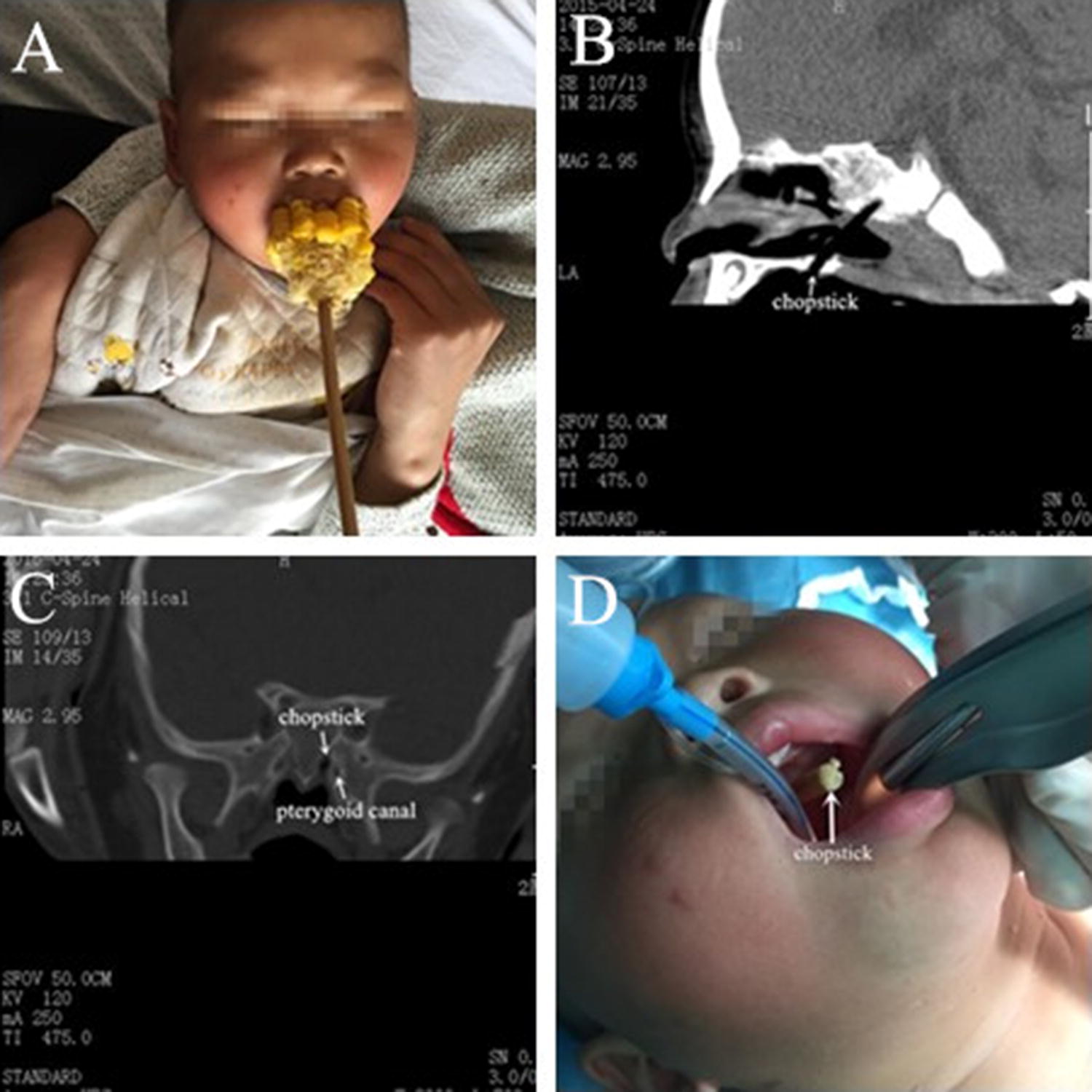
A two-year-old male patient presented with penetrating oropharyngeal trauma. He had fallen while eating a corncob skewered by a chopstick. The chopstick had lodged in the roof of the patient's mouth and the corncob occluded the entrance (Figure A). A sagittal computed tomography (CT) image showed the chopstick penetrating the hard palate, transiting the nasopharynx, and lodging into the skull base (Figure B). The coronal CT image showed that the chopstick had penetrated slightly left to the midline of the hard palate passing through the inner edge of the medial plate of the pterygoid canal (through which the pterygoid artery, vein, and nerve transit) (Figure C), though there was no sign of injury to the pterygoid canal. In the operating room, 30 mg iv ketamine was titrated while spontaneous breathing was maintained. To allow for preoxygenation with a facemask, we dissected the corncob and cut the chopstick with a surgical rongeur. The patient was then intubated after intravenous induction of anesthesia (Figure D). The surgical and postoperative courses were otherwise uneventful.
Figure

Anesthesia management of a pediatric patient with penetrating oropharyngeal trauma. A) A cobcorn skewered by a chopstick occluded the mouth. B) A sagittal computed tomography (CT) scan showed that the chopstick had lodged in the skull base, with the coronal CT image (C) showing that the chopstick had passed through the inner edge of the medial plate of the pterygoid canal. D) The patient was successfully intubated after the corncob had been removed and the chopstick cut away to allow laryngoscopy.

This case presented the anesthetic dilemma of mananging a full stomach and near complete obstruction of the oral airway. It is important to consider that the patient would likely have aspirated had he vomited, even though he was alert and had intact protective airway reflexes when he presented, as the nasal airway was too small to remove stomach contents. Also, as the penetrating oropharyngeal trauma may have caused major vascular injuries as a lateral soft palate or peritonsillar injury could have posed a potential risk to the internal carotid artery injury,1 a CT scan was urgently conducted. Had a vascular injury been suspected, CT angiography could have further identified its extent.2 Based on this patient's CT scan, if he had started to vomit before commencing surgery, we would have immediately removed the chopstick and corncob to protect the airway, despite the potential risk of hemorrhage.

Notes

Acknowledgement

We are grateful to Guoming Xie MD, PhD, MSc who provided feedback on this paper.

Financial disclosure

This manuscript was supported by the Natural Science Foundation of Zhejiang Province Y17C09009).

Editorial responsibility

This submission was handled by Dr. Hilary P. Grocott, Editor-in-Chief, Canadian Journal of Anesthesia.

Publisher's Note

Springer Nature remains neutral with regard to jurisdictional claims in published maps and institutional affiliations.

References

  1. 1.
    Soose RJSimons JPMandell DL. Evaluation and management of pediatric oropharyngeal trauma. Arch Otolaryngol Head Neck Surg 2006; 132: 446-51.CrossRefGoogle Scholar
  2. 2.
    Brietzke SEJones DT. Pediatric oropharyngeal trauma: what is the role of CT scan? Int J Pediatr Otorhinolaryngol 2005; 69: 669-79.CrossRefGoogle Scholar

Copyright information

© The Author(s) 2019

Open AccessThis article is distributed under the terms of the Creative Commons Attribution-NonCommercial 4.0 International License (http://creativecommons.org/licenses/by-nc/4.0/), which permits any noncommercial use, distribution, and reproduction in any medium, provided you give appropriate credit to the original author(s) and the source, provide a link to the Creative Commons license, and indicate if changes were made.


Improving care for elderly patients with hip fracture: interdisciplinary collaboration in regional analgesia

  • Carla Y. HendersonEmail author
  • Ramzy Abdel-Galil
  • Michael Y. Woo
  • Jacques S. Lee
  • Steven Papp
  • Susan Madden
  • Anne Lui
  1. 1.
  2. 2.
  3. 3.
  4. 4.
  5. 5.
Correspondence


Alexandros Sfakianakis
Anapafseos 5 . Agios Nikolaos
Crete.Greece.72100
2841026182
6948891480

Muscle Research and Cell Motility

Skeletal muscle fibre swelling contributes to force depression in rats and humans: a mechanically-skinned fibre study

Abstract

This study investigated the effects of fibre swelling on force production in rat and human skinned muscle fibres, using osmotic compression to reverse the fibre swelling. In mechanically-skinned fibres, the sarcolemma is removed but normal excitation–contraction coupling remains functional. Force responses in mechanically-skinned fibres were examined with and without osmotic compression by polyvinylpyrrolidone 40 kDa (PVP-40) or Dextran 500 kDa (dextran). Fibre diameter increased to 116 ± 2% (mean ± SEM) when rat skinned type II fibres were immersed in the standard intracellular solution, but remained close to the in situ size when 3% (mass/volume) PVP-40 or 4% Dextran were present. Myofibrillar Ca2+ sensitivity, as indicated by pCa50 (− log10[Ca2+] at half-maximal force), was increased in 4% Dextran (0.072 ± 0.007 pCa50 shift), but was not significantly changed in 3% PVP-40. Maximum Ca2+-activated force increased slightly to 103 ± 1% and 104 ± 1% in PVP-40 and Dextran, respectively. Both tetanic and depolarization-induced force responses in rat skinned type II fibres, elicited by electrical stimulation and ion substitution respectively, were increased by ~ 10 to 15% when the fibres were returned to their normal in situ diameter by addition of PVP-40 or Dextran. Interestingly, the potentiation of these force responses in PVP-40 was appreciably greater than could be explained by potentiation of myofibrillar function alone. These results indicate that muscle fibre swelling, as can occur with intense exercise, decreases evoked force responses by reducing both the Ca2+-sensitivity of the contractile apparatus properties and Ca2+ release from the sarcoplasmic reticulum.


The role of the microcirculation in muscle function and plasticity

Abstract

It is widely acknowledged that maintenance of muscle, size, strength and endurance is necessary for quality of life and the role that skeletal muscle microcirculation plays in muscle health is becoming increasingly clear. Here we discuss the role that skeletal muscle microcirculation plays in muscle function and plasticity. Besides the density of the capillary network, also the distribution of capillaries is crucial for adequate muscle oxygenation. While capillaries are important for oxygen delivery, the capillary supply to a fibre is related to fibre size rather than oxidative capacity. This link between fibre size and capillary supply is also reflected by the similar time course of hypertrophy and angiogenesis, and the cross-talk between capillaries and satellite cells. A dense vascular network may in fact be more important for a swift repair of muscle damage than the abundance of satellite cells and a lower capillary density may also attenuate the hypertrophic response. Capillary rarefaction does not only occur during ageing, but also during conditions as chronic heart failure, where endothelial apoptosis has been reported to precede muscle atrophy. It has been suggested that capillary rarefaction precedes sarcopenia. If so, stimulation of angiogenesis by for instance endurance training before a hypertrophic stimulus may enhance the hypertrophic response. The microcirculation may thus well be a little-explored target to improve muscle function and the success of rehabilitation programmes during ageing and chronic diseases.


The giant titin: how to evaluate its role in cardiomyopathies

Abstract

Titin, the largest protein known, has attracted a lot of interest in the cardiovascular field in recent years, since the discovery that truncating variants in titin are commonly found in patients with dilated cardiomyopathy. This review will discuss the contribution of variants in titin to inherited cardiac conditions (cardiomyopathies) and how model systems, such as animals and cellular systems, can help to provide insights into underlying disease mechanisms. It will also give an outlook onto exciting technological developments, such as in the field of CRISPR, which may facilitate future research on titin variants and their contributions to cardiomyopathies.


Insights into myosin regulatory and essential light chains: a focus on their roles in cardiac and skeletal muscle function, development and disease

Abstract

The activity of cardiac and skeletal muscles depends upon the ATP-coupled actin–myosin interactions to execute the power stroke and muscle contraction. The goal of this review article is to provide insight into the function of myosin II, the molecular motor of the heart and skeletal muscles, with a special focus on the role of myosin II light chain (MLC) components. Specifically, we focus on the involvement of myosin regulatory (RLC) and essential (ELC) light chains in striated muscle development, isoform appearance and their function in normal and diseased muscle. We review the consequences of isoform switching and knockout of specific MLC isoforms on cardiac and skeletal muscle function in various animal models. Finally, we discuss how dysregulation of specific RLC/ELC isoforms can lead to cardiac and skeletal muscle diseases and summarize the effects of most studied mutations leading to cardiac or skeletal myopathies.


The discovery of actin: "to see what everyone else has seen, and to think what nobody has thought"*

Abstract

Actin is among the most highly abundant and ubiquitous proteins in eukaryotic cells. The structure, dynamics and functional diversity of actin have continued to mesmerise cell and molecular biologists, biophysicists and physiologists for more than three quarters of a century. The discovery and initial characterization of actin, which took place in the laboratory of Albert Szent-Györgyi by Ilona Banga and Brúnó F. Straub during the second world war in Hungary, is a remarkable and inspiring moment in the history of science. Many of the early thoughts and ideas on the properties and functions of actin and particularly actomyosin, which are referred to in this short historical overview, resonate freshly even today.


Actin–tropomyosin distribution in non-muscle cells

Abstract

The interactions of cytoskeletal actin filaments with myosin family motors are essential for the integrity and function of eukaryotic cells. They support a wide range of force-dependent functions. These include mechano-transduction, directed transcellular transport processes, barrier functions, cytokinesis, and cell migration. Despite the indispensable role of tropomyosins in the generation and maintenance of discrete actomyosin-based structures, the contribution of individual cytoskeletal tropomyosin isoforms to the structural and functional diversification of the actin cytoskeleton remains a work in progress. Here, we review processes that contribute to the dynamic sorting and targeted distribution of tropomyosin isoforms in the formation of discrete actomyosin-based structures in animal cells and their effects on actin-based motility and contractility.


Troponin structure and function: a view of recent progress

Abstract

The molecular mechanism by which Ca2+ binding and phosphorylation regulate muscle contraction through Troponin is not yet fully understood. Revealing the differences between the relaxed and active structure of cTn, as well as the conformational changes that follow phosphorylation has remained a challenge for structural biologists over the years. Here we review the current understanding of how Ca2+, phosphorylation and disease-causing mutations affect the structure and dynamics of troponin to regulate the thin filament based on electron microscopy, X-ray diffraction, NMR and molecular dynamics methodologies.


The role of satellite and other functional cell types in muscle repair and regeneration

Abstract

Skeletal muscles play essential roles in physiological processes, including motor function, energy hemostasis, and respiration. Skeletal muscles also have the capacity to regenerate after injury. Regeneration of skeletal muscle is an extremely complex biological process, which involves multiple cell types. Skeletal muscle stem cells (also known as satellite cells; SCs) are crucial for the development, growth, maintenance and repair of the skeletal muscle. Cell fates and function have been extensively studied in the context of skeletal muscle regeneration. In addition to SCs, other cell types, such as fibro-adipogenic precursors (FAPs), endothelial cells, fibroblasts, pericytes and certain immune cells, play important regulatory roles during skeletal muscle regeneration. In this review, we summarize and discuss the current research progress on the different cell types and their respective functions in skeletal muscle regeneration and repair.


An acoustic myography functional assessment of cerebral palsy subjects compared to healthy controls during physical exercise

Abstract

Individuals with cerebral palsy (CP) participate in reduced levels of physical activity and spend an increased amount of time in a sedentary state compared with healthy control subjects. Whether this in part can be explained by impaired muscle function is still unclear. The aim of the present study was to elucidate differences in muscle fibre recruitment during treadmill exercise between CP subjects and healthy age-, sex- and BMI-matched controls. This is a case–control study. Acoustic myography (AMG), a method recording fibre use and efficiency from contracting muscles, was applied during a period of treadmill exercise. The recorded AMG parameters revealed that the CP subjects had a significantly lower initial S-score (spatial summation) than the controls (P < 0.01). However, the T-score (temporal summation) and the E-score (efficiency) showed no significant differences between individuals with CP and the healthy control subjects. The present findings indicate that CP subjects use a higher degree of spatial summation (more fibres recruited) to keep up the same speed during treadmill exercise when compared to healthy matched control subjects. Our results suggest that individuals with CP have a tendency to recruit far more muscle fibres during bouts of exercise than healthy individuals. This may partly explain why CP subjects experience premature fatigue.


Proteomic profiling of the mouse diaphragm and refined mass spectrometric analysis of the dystrophic phenotype

Abstract

The diaphragm is a crucial muscle involved in active inspiration and whole body homeostasis. Previous biochemical, immunochemical and cell biological investigations have established the distribution and fibre type-specific expression of key diaphragm proteins. Building on these findings, it was of interest to establish the entire experimentally assessable diaphragm proteome and verify the presence of specific protein isoforms within this specialized subtype of skeletal muscle. A highly sensitive Orbitrap Fusion Tribrid mass spectrometer was used for the systematic identification of the mouse diaphragm-associated protein population. Proteomics established 2925 proteins by high confidence peptide identification. Bioinformatics was used to determine the distribution of the main protein classes, biological processes and subcellular localization within the diaphragm proteome. Following the establishment of the respiratory muscle proteome with special emphasis on protein isoform expression in the contractile apparatus, the extra-sarcomeric cytoskeleton, the extracellular matrix and the excitation–contraction coupling apparatus, the mass spectrometric analysis of the diaphragm was extended to the refined identification of proteome-wide changes in X-linked muscular dystrophy. The comparative mass spectrometric profiling of the dystrophin-deficient diaphragm from the mdx-4cv mouse model of Duchenne muscular dystrophy identified 289 decreased and 468 increased protein species. Bioinformatics was employed to analyse the clustering of changes in protein classes and potential alterations in interaction patterns of proteins involved in metabolism, the contractile apparatus, proteostasis and the extracellular matrix. The detailed pathoproteomic profiling of the mdx-4cv diaphragm suggests highly complex alterations in a variety of crucial cellular processes due to deficiency in the membrane cytoskeletal protein dystrophin.


Alexandros Sfakianakis
Anapafseos 5 . Agios Nikolaos
Crete.Greece.72100
2841026182
6948891480